Take part in our Christmas game and try to win a handmade wooden product 🌿🎁 Take part in our Christmas game and try to win a handmade wooden product 🌿🎁
The juniper, an emblematic tree of arid zones

The juniper is a small tree or shrub that grows in the Northern Hemisphere in dry or arid areas. It is a plant that requires no special care and is very hardy. The juniper comprises many varieties and each of them has beneficial properties for human health or for nature.
Be careful though, only the common juniper and the cade juniper are edible; the other varieties are toxic.
Juniper wood technical datasheet
You will find all the information you need to help you understand and use juniper wood. We have gathered the characteristics, specifications and information of this exceptional wood.
| Characteristic | Description | |
|---|---|---|
Common name | Juniperus communis | |
Scientific name | Juniperus communis | |
Type | Shrub of the Cupressaceae family. | |
Color of the leaves | Very prickly dark green needles that grow in pairs. | |
Fruit color | Once pollinated, the female juniper forms a dark blue or red berry that ripens in 1 or 2 years, also called juniper berry. More info on the use of the berries. | |
Wood color | Juniper wood varies in color from yellow to reddish brown. With age, the wood will darken in color. | |
Height | Between 4 and 10 meters high for the Juniperus communis. Some varieties of juniper can grow up to 40 meters high. | |
Trunk | The trunk of the juniper has a rough bark and is light gray in color. It can be twisted, bent or filled with knots. It depends on the place where it grows and the environment outside. | |
Growth | Slow. About 30 to 60 centimeters per year. | |
Lifetime | Between 50 and 500 years depending on the variety of juniper. | |
Hardness | Very hard and rot-proof wood, which means that it is a wood that does not rot. | |
Fruit | The female juniper will produce berries. The color of the berries varies according to the variety of juniper. Some are edible while others are poisonous. Learn more about the berries. | |
Leaf | The shape of the leaf varies depending on the variety of juniper. They can be in the form of pointed or soft needles or in the form of scales. | |
Flowering period | In spring, between March and May. | |
Juniper wood availability | ★★★★☆ | |
Price of juniper wood | ★★☆☆☆ | |
Disease and pests | Juniper is subject to one disease in particular: pear rust, which causes a lot of damage to leaves and fruit. Red spiders, beetles and scale insects are the main pests of juniper. |
Description of juniper wood
Take a closer look at the characteristics and uses of juniper wood, as well as its health benefits and its advantages as a craft and decorative material.
The regions of the world where to find the common juniper
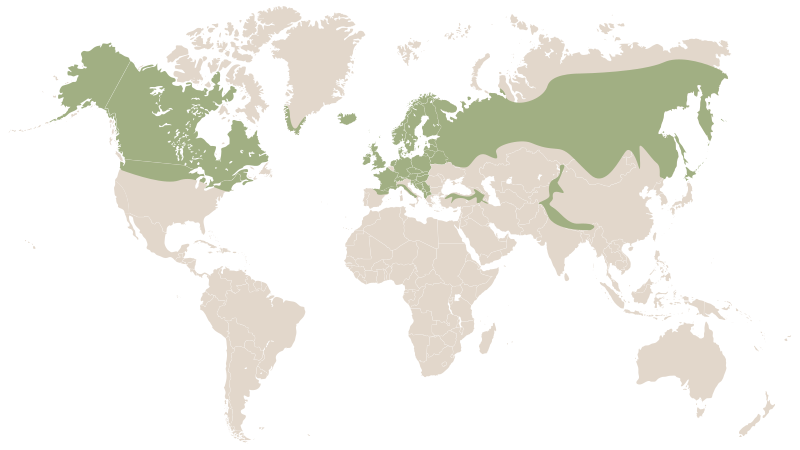
The common juniper is the most widespread variety in the Northern Hemisphere. It is found abundantly in France in mountainous and rocky areas. The common juniper prefers rocky, sandy and calcareous soils.
It can be found in:
- North America
- Canada
- Northern Europe
- Russia


What does a juniper look like and how do you recognize it?
Here, I will show you how to differentiate the Juniperus communis from other varieties. Photos 5 and 6 show Juniperus communis and Juniperus sabina respectively in their environment.
- Juniper leaf
The common juniper (photo 3) has very prickly green needles with a white band in the center. The cade juniper (photo 1) has fine, prickly needles with 2 white bands in the center. The Phoenician juniper (photo 2) has small, blunt needles.
- Juniper flower
Junipers are dioecious trees, the males and females are different in appearance and do not produce the same thing. Indeed, the female juniper will produce fruits containing seeds (photo 2) whereas the male juniper will produce pollen which, with the wind, will arrive on the female plants.
- Juniper fruit
Juniper produces small, round berries called juniper berries (photo 3). These berries are green and change color when ripe. However, you should be careful because some junipers produce toxic berries. Each variety of juniper produces a berry of a different color, shape and size.
- Trunk and bark of the juniper
The trunk of the juniper has rough bark and is mostly light gray in color, except for the Virginia juniper which has a reddish bark. Because of the location where it grows (rocky and mountainous area), the trunk can be twisted and even bent as it follows the shape of the rock on which it grows (photo 4).
The Different Varieties of Juniper
Discover the most common juniper varieties in the world and information such as leaves, fruits, growth, etc.
Common juniper
Juniperus communis

Cade Juniper
Juniperus oxycedrus

Savin juniper
Juniperus sabina

Phoenician juniper
Juniperus phoenicea
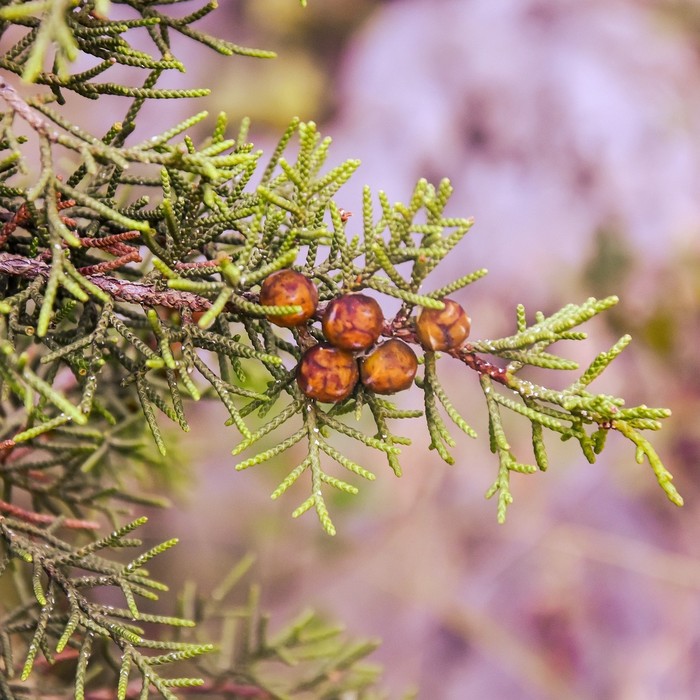
Chinese juniper
Juniperus chinensis

Virginia juniper
Juniperus virginiana

Juniper wood, a durable wood with multiple uses

Juniper wood is the worst enemy of axes or chainsaws because it is very hard with a very tough heartwood. It is also a rot-resistant wood, which means that it does not rot.
In craftsmanship, juniper wood is used by woodturners to make tableware, vases or decorative objects. It is a very beautiful wood that gives off a pleasant scent.
In everyday life, juniper wood is used as firewood because it burns slowly and gives the room a pleasant scent.
In gardens, juniper is much appreciated and often used for hedges because it is very robust. Juniper can also be used with greater delicacy and care as a bonsai.
Let's eat! Juniper is on the menu

Juniper can be consumed in several forms, as I explain just below.
Flavouring dishes
Juniper berries are excellent for flavouring fatty dishes such as meat, game or sauerkraut. The berries will add good flavour to the dish and also aid digestion.
Use as a paste or jam
In the French mountains, the berries are cooked and then pressed to make a honey-like paste. This paste is eaten with bread.
Creating alcoholic drinks
Juniper berries are used to create multiple alcoholic drinks.
- Genever, a spirit flavoured with juniper berries. It is a speciality of Belgium, the Netherlands and northern France and Germany.
- Sahti, a beer from Finland flavoured with juniper berries and filtered with juniper branches.
- Gin, known to all, is an alcohol flavoured with juniper berries.
☠️ One must be extremely careful when consuming juniper; some are poisonous. Only the common juniper and cade are edible. ☠️
The benefits of common juniper, a medicinal plant with multiple virtues

- Some indigenous peoples of North America burn the branches and needles of common juniper. Then they eat the ash which is very rich in calcium.
- Incense is made from juniper wood powder. Some people use it to sanitize and purify rooms.
Juniper berry, various and healthy uses

First of all, you should know that only Juniperus communis and Juniperus oxycedrus are edible.
As mentioned above, the berries are used to flavour dishes and to make alcohol. But they are not only used for that:
- Juniper berries are a natural diuretic and will therefore help treat water retention for example.
- Juniper berries help digestion by stimulating the production of digestive enzymes and therefore relieve abdominal pain and improve digestion.
- In infusion, juniper berries help to relieve joint pain and urinary tract infections.
- Juniper berries are rich in antioxidants. They can be crushed and used as a marinade for fish or eaten in smoothies. They will bring flavor and benefits.
- The essential oils created with juniper berries have many virtues.
Juniper essential oil: characteristics and uses

Juniper essential oil is obtained by steam distillation of juniper berries and branches.
This pale yellow essential oil has a woody, spicy aroma. It can be used by inhalation to relieve coughs. It can also be used in massage to relieve inflammatory pain. Finally, juniper essential oil can be mixed with a cream to treat skin problems and aid healing.
Juniper in bonsai, the natural art

Some wood species used to make bonsai are pine, Chinese elm, maple, Chinese juniper and Juniperus sabina.
Juniper is a good choice for making bonsai for several reasons:
- The leaves of the juniper: they are small, which gives the bonsai a more realistic appearance
- The trunk of the juniper: it naturally has an atypical shape, a worked, gnarled trunk with multiple small branches, allowing it to be shaped in many ways.
- The robustness of juniper: juniper is a hardy tree that tolerates difficult growing conditions and frequent pruning very well. Poor soil in a pot and warm temperatures like those inside a house do not bother it.
- The bark of the juniper: with age, it cracks and changes in texture and color. This adds life and relief to the bonsai and gives it a more attractive appearance.
To make a bonsai with juniper, here are some tips:
- Choose a young juniper with a straight trunk
- Prune the branches to create compact and atypical shapes
- Prune the roots of the juniper to limit its growth and prevent the bonsai from becoming several meters tall.
- Keep the bonsai's soil moist and let it enjoy a few hours of sunlight every day to support its growth.
The worst disease for juniper

Juniper is very susceptible to fungal diseases. The disease that affects juniper the most is pear rust. This disease only affects junipers and pear trees. Also, it needs 2 hosts to live, the primary host being the juniper which is affected in winter and the secondary host the pear tree which is infected in spring. This disease spreads with the wind but also with insects like bees.
When spring arrives and the weather is both mild and wet, brown cones form on the branches of the juniper. These cones then become orange masses, as shown in the picture.
The natural and varied beauty of juniper
A collection of carefully selected images to inspire you and arouse your curiosity.


Discover the incredible versatility of wood through various species and the world of woodworking. By subscribing, you will receive information about wood and its species once a week.
Discover other wood species
A varied selection of woods highlighting the beauty and diversity of wood species around the world.


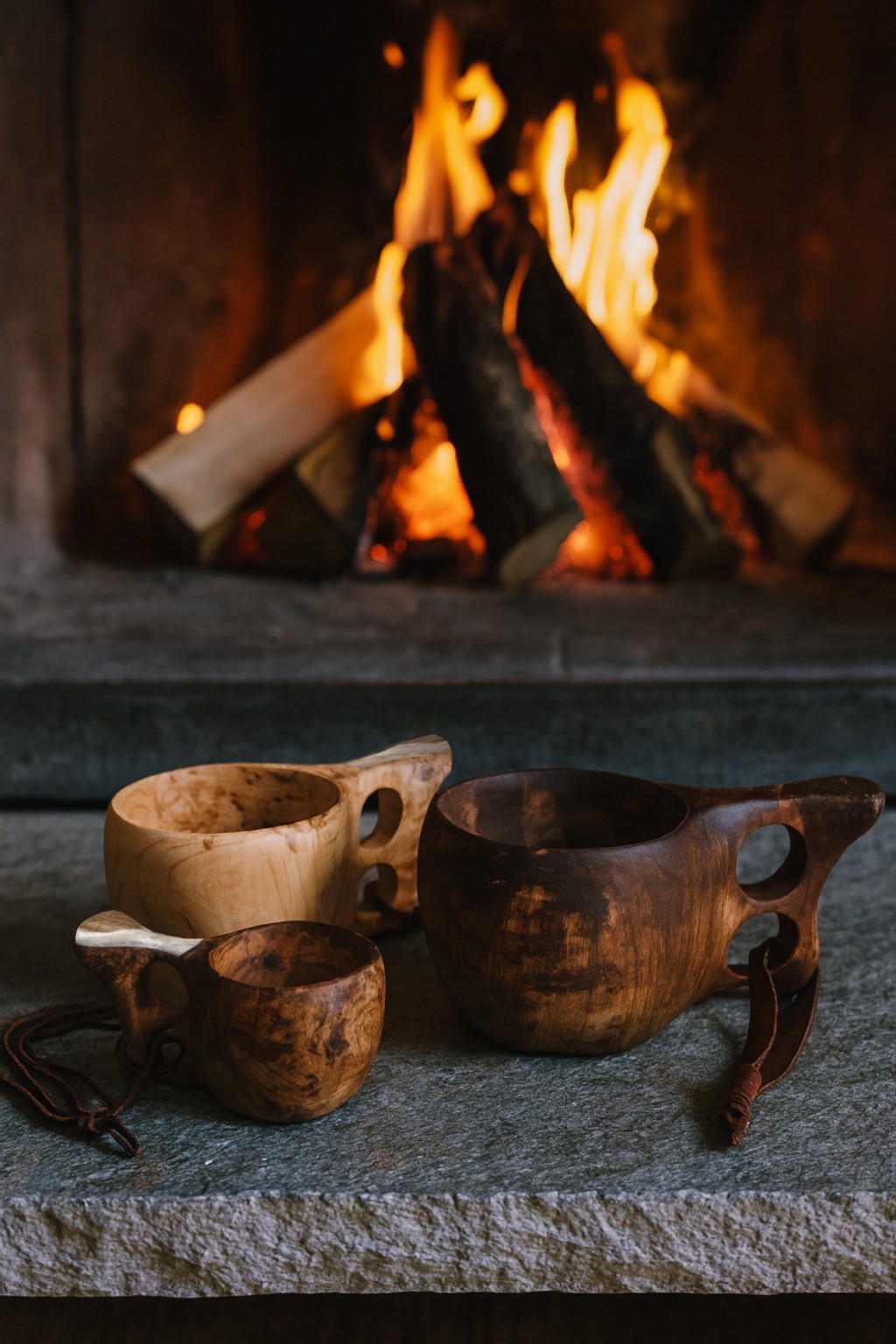
For Christmas, try to win one of our 3 favorite kuksa. A handmade wooden mug to celebrate the festive season. 🎄
To enter, add your email address below
Contest results on December 21. 🍀